Showing posts with label canada. Show all posts

Thursday, February 06, 2014

This winter's rabbit.

rabbit tracks in the snow

Last summer's rabbit (the one that ate all of my kale, my broccoli, my cauliflower, chewed luscious greens into tiny, hard stems; the one that I suspected was coming under the neighbour's fence and which I might have even thrown a pebble at to scare away — had one been handy), the very same rabbit, has been leaving tell-tale tracks in the overnight snow.

This morning, it appeared, coming through the drifts between the houses, and stopped at the bush with the red berries. I put down the dish I was washing and called my son and held him in my arms while we watched the bunny.

Tuesday, December 11, 2012

capturing december 9: what I'm reading


Kate DiCamilo is an incredible writer who happens to mostly write children's books.

Tuesday, December 04, 2012

capturing december 4: joyous


We're still living with the flu over here, so here's a joyous shot of Jasper & I from last week at the Toronto Christmas Market. Photo by Kate Sheffield.

Friday, July 01, 2011

marking the season

This amazing watercolour work by Poppy and Pinecone reminds me of squished strawberries. Watch for me in the Cobourg parade, along with the rest of SVFF.

Sunday, August 22, 2010

icebreaker


The truth has been slowly whispering its way into my heart: I'm not one of them.

I might not be a northerner. Not a thirty-years in lifer, and probably not going to be one. Although I always wished I might be. You know those people with their romantic and rugged austerity in the face of those two mighty arctic elements: nature and time. For me, the words "polar night" are a bit scary.

At the root of the matter is the fact that I'm a farmer at heart (in whatever context the word could apply: I am a naturally-inclined homesteader, I am interested in planting seeds and gathering harvest and the husbandry of many good things), and this is a place with no farms.

That said, I'm not ready to retreat south of 60 yet. I've enjoyed many experiences and gifts in my arctic sojourn so far, and here are a few things I've learned:


  • I'm living in a town with a population of 200. This has taught me the safety of being known and knowing. The joy of acknowledging casual acquaintanceship. The excitement of being welcomed back.

  • the pleasures of living without a lot of stuff are many. I'm currently living out of two suitcases' worth of books, craft supplies and clothing, and doing just fine.

  • the pleasures of living without a lot of stuff to buy are also many. The only store in Resolute is about the size of my apartment's living room. This is not a downside.

  • learning to read and enjoy the sky just as much as the land.

  • Just a few telephone lines and the sunset and the horizon for miles. I don't even believe there's such a thing as a silhouette below the treeline anymore.

  • if you dress properly (as opposed to fashionably), winter is really fun.

  • wild and local food sources need to be protected as vital sources not just of nutrition, but of culture and community-building.


Now that I've had some time to think about it, I might just stay.


Photo of the Louis Saint Laurent, a Canadian Coast Guard icebreaker that is currently breaking ice on its way here. By Yann Arthus-Bertran

Thursday, May 06, 2010

six degrees of resolution


I can't see them, but I can hear the sled dogs tied up out on the shore howling along the wind. Fat flakes are limiting the view out the window to a hundred feet or so, and both flights out of town have been cancelled. It's a good day for staying in.

After four flights, and four days of travelling (I spent two Iqaluit, the capital of Nunavut), I finally made it to Resolute--and was promptly thrown into busy job of running a hotel.
Though we're tied down at the place most days, our job comes with the benefit of meeting all kinds of people who are travelling through for a huge variety of reasons: scientific research, personal expeditions, government business, sport hunting, etc. This kind of traffic is nothing new in Resolute--it's been a key location in high arctic activities for as long as such a thing has existed.

Par example: Resolute is named after a the HMS Resolute, a British naval ship dispatched to search for the lost Franklin expedition. The HMS Resolute was trapped in pack ice and abandoned in May 1854. Eventually thawing out, the crewless ship floated out towards Baffin Island, where it was found by an American whaling ship. The US government fixed her up and sailed her home as a little gift for England, where the ship was put back into naval service until 1879. When it became unseaworthy, Queen Victoria did another good deed and had the broken up ship built into two desks, one as a present for President Hayes, the other for Buckingham Palace.

Which brings us to the Resolute desk, used by all but 2 presidents (and they were LBJ and Nixon...).

Wednesday, April 01, 2009

She doesn't play tricks.


  1. This is the way the espresso maker works. You fill the bottom with water to where the screw is. You put espresso coffee grinds into the strainer and fit it in the bottom. Screw the top on and put it on the element turned to high (a small element because my mom recently told me not to put small things on large elements). 
  2. My dad took me into the basement before I left after Christmas. Pieces of paper and photographs and projects on tables all around, laundry escaping baskets in the corner. "I have some books, do any of these interest you?" I take Alice Munro, George Elliot Clarke. 
  3. I read Who Do You Think You Are
  4. I take notes, notes about Alice Munro and Canadian women. Notes for a class discussion that will not happen, notes for an exam that is not coming, notes for what? I write notes by hand. 
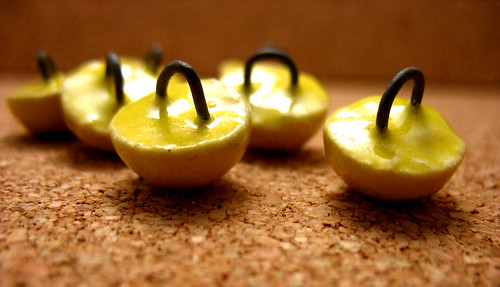
  5. At the Salvation Army, I buy an impossibly full bag of buttons, colorful old buttons, all shanks (what are the chances of this?) with their proud fronts and practical backs. I have no plans for these buttons, there is no dress in the works that requires hundreds of shank buttons down the back, each its own size and colour. Buttons for what? 
  6. I'm won over by their packaging, a rinsed out and yellowing milk bag with two staples in the top. $2 spent on a rinsed out milk bag and no plans. When she lived with us, my nana would keep milk bags rinsed and folded in the bottom drawer in the kitchen.
  7. My beardy, thoughtful, 48-year old uncle does the 25 things meme on Facebook and mentions Alice Munro. My notes are probably wrong, then. I've been overfeminizing her, feeling at once too much claim on her and too much distance. I didn't know men liked Alice Munro. 
  8. Alice Munro has a pattern, writing shadows of the same characters and the same stories over and over. Practicing for perfect and welcoming suspicions of autobiography. This is what we have: rural poverty; graphic and vivid experiences of life/death/sex/shame; tweedy, gifted women students who are ahead of their time (here we may meet Atwood, cross paths with each other on a slushy street corner, both cold and shabby and waiting for the street car; ridiculously small adult luxuries that may grow into a strangely unfulfilling freedom or ill-fitting middle class comfort. 
  9. Gravity reverses and parts become a whole. Coffee pours up through the strainer into its holding chamber, and is poured into a pot. Two tablespoons of sugar, the rest of the milk. 
  10. Do I rinse out the bag? Rinse it out, let it dry, fold it over and keep it in a drawer for future purpose? What would I save a milk bag for? 
  11. After dinner, in the living room with our coffees and candles, my best friend practically whispers: "Alice Munro is boring." She says she feels like she has to go out outside and spit 3 times for saying it. Attracting the evil eye of Canadian literature. It's never occured to me, but it might be true. She might be boring. But then, that might just be the trick. 
  12. The sound the buttons make when poured into a pile. 
  13. The sound the coffee makes when poured into a mug. 

Thursday, March 13, 2008

the only people for me are the mad ones


Amidst the snow and sadness of the winter, I've been bunking down in the ivory tower (a.k.a. Stauffer Library) with my homeys (see photo) catching up with my first love, the Beats. Though they've become the cliched territory of stoner-buddhas and supposedly high-minded frat boys, I've always felt pretty sincere in my affections for Jack and the boys. I read Dharma Bums for the first time when I was 16, and it felt like waking up--like I'd been asleep for my whole life. In honour of these two crazy kids, long hours at the library for no reason, over-the-counter uppers and late nights (or early mornings) singing along with Dylan, a list.

Top Ten Things To Do in a Kerouac Novel/Poem/Letter

10. Get all confused and hung up.

9. Abstractly refer to Buddhism, God and America. Interchangeably, if possible.

8. Take bennys.

7. Worry about your mother. Refer to your mother, her cat, and your belongings as “the ménage.”

6. Get a ride with/pick up some hitchhiking Okies.

5. “Ball” with girls. Descriptions of said girls should be based on their occupations and hair colour. Note: if in spiritual phase, refer to sex as “yabyum.”

4. Reminisce about your golden youth in a small and snowy New England town.

3. Go and never stop going till you get there. You don’t know where you’re going, but you gotta go.

2. Drink a lot, worry about how much you’re drinking, swear to stop drinking, repeat.

1. Dig/be dug by someone.


Tuesday, January 22, 2008

"It comes to me that fear of death is, from another angle, love of the world."


Originally printed in the Journal (Vol 135's Literary Supplement) in a collection of books for each season, this is the book I've been talking about to anyone to will listen lately.

When I Was Young and In My Prime - Alayna Munce

During the season of short days and long nights, it's easy to find refugre in that which is static--though life, as this book's narrator discovers, rarely stands still. When I Was Young and In My Prime skips between and around generations of one family, telling their stories with raw and beautiful concision, from Mennonite children in revolutionary Ukraine to broken bones on backyard ice rinks in rural Ontario to the painful awkwardness of old age.
Through diary entries, lists, poems and prose, over and over again, Munce nails the everyday, the mundane, with knowledge that comes from the heightened awareness of pain.
Our narrator is a young woman in her mid-twenties living in the Parkdale area of Toronto, who splits her time between waitressing in a bar* and writing. She's a version of Munce, and the book walks a blurred edge between fiction and autobiography--its truth is that palatable.
When I Was Young paradoxically provides comfort in its realism and its simple acceptance of the things that are beginnings, ends and everything in between.


(Need more? The title of this entry comes from the author's description of biking home through Toronto's rush hour, towards the sunset. Truth.)

*Rumour has it the bar she works at in the novel is Mitzi's Sister (pictured above). Live music every night. Queen West at Dowling, or so.

Thursday, January 17, 2008

sometimes a person's hands are the only words she knows


Something new I've stumbled upon this year (one of those so-close-you-trip-over-it discoveries) is the writing of Bronwen Wallace. Born in Kingston, Wallace taught at Queen's and St. Lawrence, worked at Interval House (a women's shelter) and wrote. Wrote, wrote, wrote. Wrote her heart out, wrote till it was spilled out and wrote till it was stitched back up. She had a weekly column in the Whig during the '8os (ahh, the institutional legacy: some comfort in a past that nothing can buy out), she argued about the usefulness of language in feminism with fellow poet Erin Mouré, she wrote intelligent, angry poems about violence against women and she wrote poems about the land north of Kingston in which, through disconnected family lines and dusty county lines, I've come to find something of a home.

Wallace died of cancer in 1989, and I'm feeling the loss of her 20 years late.

If I had a god,
I'd say we were holy and didn't know it,
but I see only what we make of ourselves on earth,
how long it takes for us to love what we are,
what we offer to each other only in our best moments,
but carelessly, without shyness,
like food grown in plenty,
our mouths blessed with it every day.

--Bronwen Wallace, from What It Comes to Mean, in Common Magic, 1985


*This spring, Queen's is hosting a conference called Common Magic: The Legacy of Bronwen Wallace in March. Kingstonians, and others, look
here for more. Rumours that Emmylou Harris might be playing were unfounded--the big concert is Kate & Anna McGarrigle.

**Grace O'Connell, former writer for the Queen's Journal, a former "who" of the University's literary "who's," etc. was one of three finalists for the Bronwen Wallace Award for Emerging Writers (the award was recently picked up by RBC and now comes with cashola to the tune of $15 000 for the winner). Marjorie Celona won the award for her story "Othello."


And one more:


It's never easy.
Even the effort of a few steps
from the bedroom to the kitchen, say,
or a few muscles, opening my eyes
to find you still there in bed beside me
is an act of magic or faith,
I'm never sure which.

All I know is that it's learned
by doing, over and over again,
like any other trick,
until you don't need to think about it.
Like now. Like the way I'm walking home
to you through this city I've learned to accept
as the only kind there is: five o'clock,
night coming down and rain
just hard enough
to make the crowds on the corners shove a little
when a bus finally splashes to the stop.
Outside a restaurant, two men shake hands
and a little boy holds his father's
as they watch a toy airplane turning in a shop window.
It could be anywhere. But what I want you to notice
are the women. They are wearing white nurses' shoes,
or dirty sneakers or high-heeled boots.
They carry briefcases and flowers, bags of groceries
as they hurry home to their husbands and kids,
lovers, ailing parents, friends.
We all have the same look somehow.

See: over there by the bank
how that stout woman lowers her eyes
when she passes that group of boys,
how her movement's mimed
by the blonde, turning her head
when a car slows down beside her.
Even the high-pitched giggle of the girls
in that bunch of teenagers is a signal
I've learned to recognize. Tuned in
on my own tightened muscles, jawline or shoulders.
In fact, you might study the shoulders.
The line of the backbone too; arms and hips,
the body carried
like something the woman's not sure what to do with.

I've already told you that this is an ordinary city.
There are maps of it and lights to show us
when to walk, where to turn.
What I want you to know is that it isn't enough.

On a trip to Vancouver once
I discovered clearer landmarks. Red ones,
sprayed on sidewalks all over the city.
They marked the places
where a woman had been raped,
so that when I stepped out of a coffee shop
to find one on the pavement by the laundromat
geography shifted.
Brought me to the city I'd always imagined
happening in dark alleys, deserted parking-lots,
to somebody else. Brought me home in a way,
no longer the victim of rumours or old news,
that red mark planted in the pavement
like the flag of an ancient, immediate war.

I used to hope it was enough
that you are gentle,
that I love you,
but what can enough mean any more,
what can it measure?

How many rapes were enough
for those women in Vancouver
before they got stencils and spray paint
made a word for their rage?
How many more until even that word
lost its meaning
and the enemy was anything that moved out there.
Anything male, that is.

How can any woman say
she loves a man enough
when every city on the planet
is a minefield
she must pick her way through
just to reach him?

It's not that we manage it though.
It's that we make it look so easy.
These women wearing their fear
like a habit of speech or movement
as if this were the way
the female's body's meant to be.
The way I turn the last corner now,
open the door to find you
drinking wine and reading the newspaper,
another glass already filled
and waiting on the coffee-table.

When I turn on the hall light
the city will retreat into the rain,
the tiny squares of yellow
marking the other rooms
where men and women greet each other.
It's a matter of a few steps,
magic or faith, though it's not that simple.
The way the rain keeps watering the cities of the world.
How it throws itself against our window,
harder, more insistent,
so that we both hear.

--Bronwen Wallace, To Get To You, from Common Magic

Tuesday, October 02, 2007

late night Can-Con and other Southern Ontario Gothic dreams

Last night I fell asleep with the TV on (the TV being an adorable, 4-inch little black and white number that requires a less-adorable amount of effort to receive a signal).
On a good day, I get two channels. Last night it was just me and the CBC.
Sometime between three and four a.m., I woke up with a start. A fuzzy orchestral version of "Oh Canada" was blaring, sounding rough and embarrassingly grandiose through the tiny speakers and a bit of static. It took me a minute to figure out its origin; the bathroom was my first thought.
The camera was wildly swooping over boldy "Canadian" scenes. I think I saw a moose, but definitely water. Maybe a Group of Seven/Georgian Bay tree? I leaned over and turned it off.
This morning, I complained to a friend. "What's with the CBC?"
I was reassured in the only way Canadians know how. You're not the only one, and someone's already written about it. Better yet, you've probably heard it on the CBC (that glorious factory: source of our greatest disdain, our greatest consolation).

See the chorus of Joel Plaskett's "True Patriot Love."

We all go out
Then we all come home
But I fall asleep with the TV on
At 3 AM they play "O Canada"
True patriot love and lalalalala


When I woke this morning, I swore there was a scene from Expo (you know the one) or maybe the Montreal Olympics. There's not. (See Mama Sheff's comment below). I'm just crazy.